Royals Address Outfield Weaknesses, but Is More Help Needed?
After bringing in Lane Thomas and Isaac Collins, are the Kansas City Royals set in the outfield, or do more moves need to be made?
The Kansas City Royals finished 82-80, just their second winning season since they won the 2015 World Series. Unfortunately, they missed the postseason, a disappointment given they went 86-76 and reached the ALDS in 2024.
Even though they won four fewer games in 2025, the Royals were not bereft of talent.
Bobby Witt Jr. and Maikel Garcia both made the All-Star team, and they ended up posting fWAR marks of 8.0 and 5.6, respectively. They also won Gold Glove awards, and Garcia received a five-year extension to keep him and Witt in Kansas City until at least 2030.
In addition, Vinnie Pasquantino stayed healthy and led the Royals in home runs (32) and RBI (113). Salvador Perez wasn’t far behind, as he hit 30 home runs and collected 100 RBI. After back-to-back triple-digit RBI totals, the Royals rewarded Perez with a two-year extension to keep the catching legend in Kansas City.
The pitching staff also produced a stellar campaign, despite being plagued by injury.
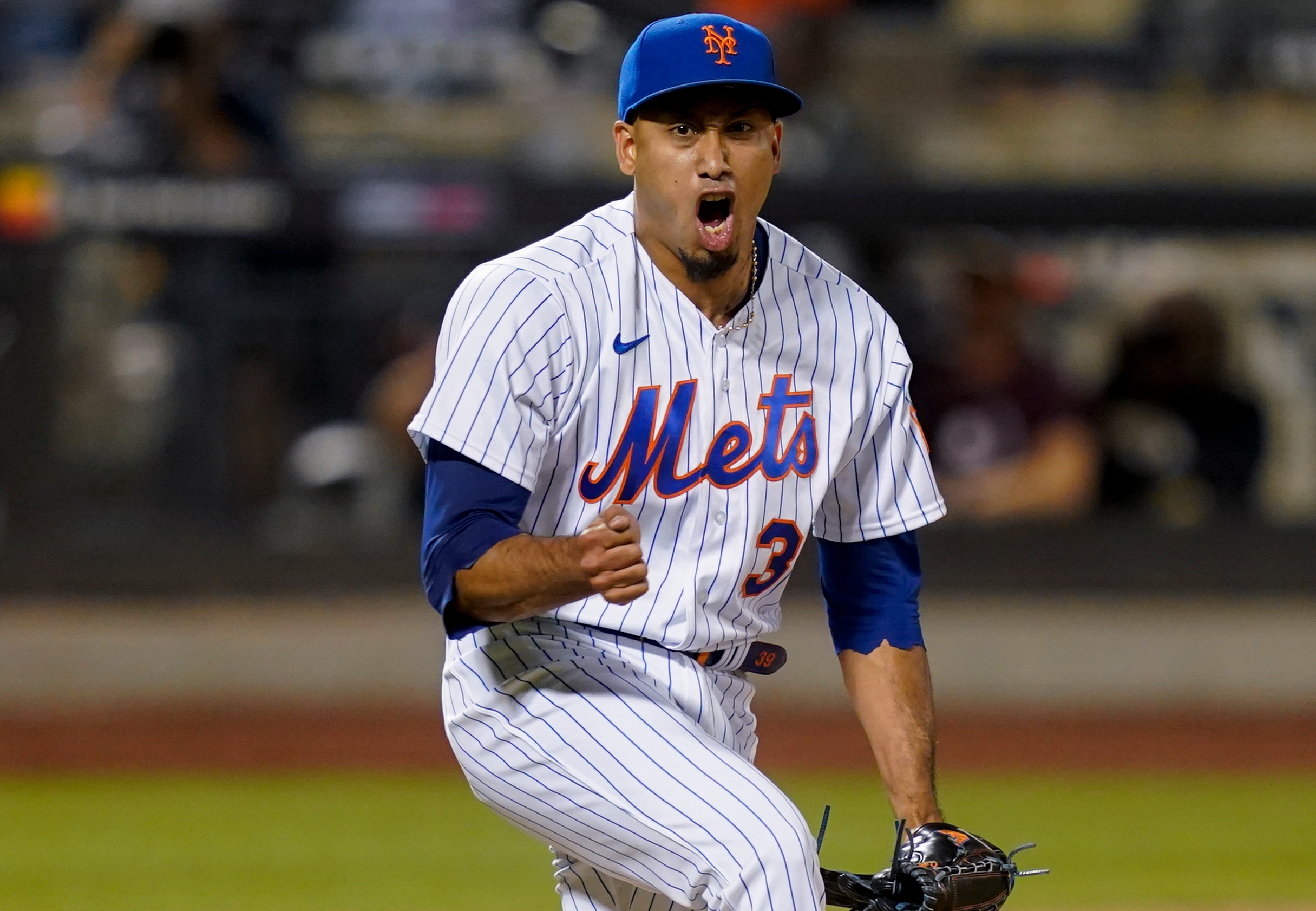
The pitching staff ranked 6th in baseball in ERA and ninth in pitching fWAR. Michael Wacha and Kris Bubic posted fWAR marks over 3.0 last year, and Cole Ragans posted a 2.1 fWAR despite only pitching 61.2 innings due to a shoulder injury. Lastly, Royals closer Carlos Estevez led the league in saves, something that hasn’t been done by a Royals reliever since Dan Quisenberry.
Unfortunately, what brought the Royals down in 2025 was their ineptitude in the outfield, especially at the plate.
Kansas City’s outfielders ranked last in batting average (.219), wRC+ (70), and fWAR (-1.4). When looking at the Royals on an individual outfielder basis, only two Royals outfielders sported fWAR marks over 1.0: Kyle Isbel and Mike Yastrzemski (who didn’t join the Royals until after the trade deadline).
Clearly Royals GM JJ Picollo made improving the outfield a priority this offseason, whether through trade or free agency. So far, he’s been true to his word, acquiring free agent Lane Thomas and Isaac Collins via a trade with Milwaukee (reliever Nick Mears also came with Collins in the deal for Kansas City reliever Angel Zerpa).
Let’s break down those crucial moves and determine whether or not the Royals must acquire one more outfielder this offseason to help solidify their divisional and playoff chances for 2026.
Can Lane Thomas Bounce Back in Kansas City?
The Royals’ first outfield acquisition was Lane Thomas, whom they acquired on a one-year, $5.2 million deal. Kansas City made the deal official on social media on Wednesday.
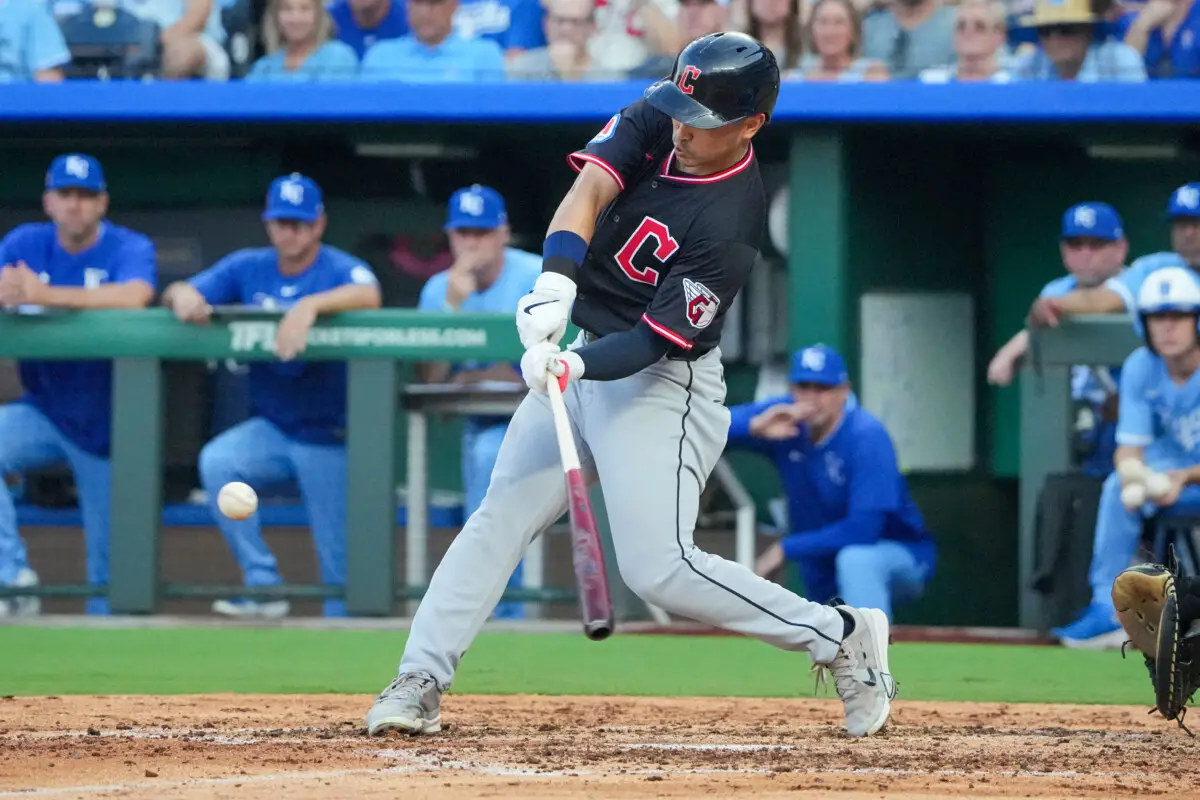
Thomas is coming off a rough, injury-plagued 2025 season in Cleveland. With the Guardians last year, he only played 39 games and didn’t do much in that sample. In 142 plate appearances, the outfielder slashed .160/.246/.272 with a 48 wRC+ and -0.5 fWAR. While that stat line is brutal, he was affected by wrist and foot injuries all season, landing on the IL three times.
The Royals are hoping that a healthy Thomas can bounce back in his new surroundings, especially as a right-handed outfield bat — something the Royals lacked last year. Kansas City right-handed outfielders ranked 28th in baseball in wRC+ with a 59 mark.
For his career, Thomas has had a 135 wRC+, .208 ISO, and 0.48 BB/K ratio against lefties. He also produced a 99 wRC+ in 528 plate appearances last year with the Nationals and Guardians and a 109 wRC+ in 2023 with the Nationals. At the very least, the Royals could utilize him as a fourth outfielder who can play all three positions and definitely slide into the lineup against left-handed starting pitchers.
An interesting trend to watch with Thomas is whether being out of Cleveland will result in a favorable bounce back.
In 329 plate appearances with the Guardians, Thomas slashed .189/.258/.340 with a .598 OPS. When looking at his xwOBA rolling chart, he saw a sharp drop in xwOBA after the trade deadline in 2024, and it never bounced back in 2025 (though the latter was likely due to injuries).
Based on his xwOBA trend over his career, Thomas has shown an ability to bounce back after down seasons, with 2021 and 2023 being prime examples. The Royals are banking on Thomas having one of his patented rebounds in Kansas City, with the hope that he is fully healthy to do so.
Collins Brings a Disciplined Approach to the Lineup
After acquiring Thomas, the Royals made a bold move, trading away Angel Zerpa to the Brewers for Nick Mears and Isaac Collins. While Mears brings a much-needed, high-velocity arm to the bullpen, the Collins move is the prize of the deal.
As an older rookie at 27 years old, Collins finished fourth in the NL Rookie of the Year race. In 441 plate appearances, the former Creighton product slashed .263/.368/.411 with a 122 wRC+, nine home runs, 56 runs scored, and 16 stolen bases. He ended up accumulating a 2.6 fWAR in 130 games, which was tied for the fifth-best mark among Brewers position players last season.
While the results were solid, it’s Collins’ approach that made him such a desired target by the Royals this offseason.
Not only did Collins post a 12.9% walk rate, but he also sported a BB/K ratio of 0.61. His 18.4% chase rate ranked in the 98th percentile, and his 22.5% whiff rate ranked in the 63rd percentile. Add that with solid defense, and it makes sense why Picollo traded away a valuable pitching asset like Zerpa to Milwaukee for Collins.
Here’s what Picollo said about Collins in a recent piece by MLB.com Royals beat writer Anne Rogers:
“He’s the type of player that we value,” Picollo said. “Versatility, the speed component, there’s a defensive component. Ball in play, on base. It’s a very well-rounded player that I think is what our offense needs. He’ll fit very well.”
Collins did regress at the end of the season for the Brewers, as he hit .191 in September. That said, he still posted a .345 OBP that month. Collins’ ability to still get on base despite a slump is a trait that can boost the Royals’ lineup immensely in 2026, especially since Kansas City ranked 22nd in OBP a season ago.
While Thomas will probably start the year out as a fourth outfielder who could work himself into a starting role with a hot start, Collins could likely be Kansas City’s Opening Day left fielder.
That is, of course, the Royals don’t make another big splash this offseason.
Could Jarren Duran Be Next for Kansas City?
One name that is frequently listed as a trade target for the Royals this offseason is Jarren Duran of the Boston Red Sox. Duran was reportedly a trade target of Kansas City at the trade deadline last season, and it seems like the Royals have maintained interest in acquiring him this winter.
That said, the Red Sox seem keen on getting a return that includes Ragans. As of now, it doesn’t appear like Picollo and the Royals are willing to budge just yet.
Duran is coming off a solid season for Boston in 2025. In 696 plate appearances, the former Long Beach State product slashed .256/.332/.442 with a 111 wRC+, 16 home runs, 86 runs scored, 84 RBI, and a 3.9 fWAR.
That said, last season was a regression from 2024, when he posted a 131 wRC+, 6.8 fWAR, and made the All-Star team (and earned All-Star MVP honors).
With other high-profile outfielders like Roman Anthony and Wilyer Abreu, Boston may not be interested in an expensive long-term deal to keep Duran. Thus, it makes sense that the Red Sox would float him in trade talks to get something of value now, just in case he regresses further in 2026.
As for the Royals, Duran represents a tough dilemma.
On one end, Kansas City has followed a more responsible blueprint, similar to those of strong small-market franchises like Milwaukee, Tampa Bay, and Cleveland. On the other hand, this is a city used to winning, with an owner, John Sherman, who’s willing to open the pocketbook for the right players.
The extension to Witt in 2024, Ragans’ and Wacha’s last year, Lugo’s at the end of 2025, and Garcia’s this winter illustrates that.
The Royals will likely be improved with Collins and Thomas. ZiPS projected the Royals to be an 82-to-86-win team before those transactions, so their additions will likely bump that win total by a game or two.
The acquisition of Duran could further catapult the Royals from a fringe playoff team to a pennant contender, especially if the pitching staff can return to 2024 form (both in health and performance).
The main question now for Picollo is this: How much is Duran worth in their eyes? Would they be willing to give away an asset like Ragans? And if not, would a package involving a pitcher like Kris Bubic or Noah Cameron be enough for Boston, which is still questionable at the end of the rotation?
Just Baseball’s Jordan Leandre pondered this question and presented several scenarios, showing how complex this trade could be for both squads.
Do the Royals need Duran to be competitive and improve in 2026? Probably not. Collins, Thomas, and a rejuvenated Jac Caglianone may be enough.
That said, a player like Duran could be the much-needed boost they need to truly turn around an outfield that was such a glaring weakness over the past two seasons (-0.3 fWAR from 2024 to 2025; good for 28th in baseball).
Three Trade Packages the Royals Can Make for Jarren Duran
One of the worst-kept secrets this offseason is the Kansas City Royals‘ pursuit of outfield help.
Over the weekend, they lost right fielder Mike Yastrzemski to the Atlanta Braves, signed free agent Lane Thomas, and acquired Isaac Collins in a trade with the Milwaukee Brewers.
The only thing more publicized than the Royals’ pursuit of outfielders is the Boston Red Sox having too many. ESPN’s Jeff Passan reported ahead of the Winter Meetings that there was a 50% chance that Jarren Duran is traded this offseason — an equal percentage for Wilyer Abreu.
League-wide reporting suggests Duran has the most suitors, or he’s at least the most poachable of the bunch. Either scenario makes sense; Abreu remains somewhat an unknown entering his age-26 season, while Duran has an All-Star Game MVP and 6.8-fWAR season under his belt.
The Royals were heavily linked to Duran all winter. That is, until they acquired Collins; the dream died there.
And yet, it re-birthed less than 48 hours later with a report from Ken Rosenthal that the Royals still covet the 29-year-old outfielder.
The Royals ranked 30th in fWAR in left and right field in 2025, tied for 24th in center field. Overall, Kansas City’s outfield contingent amassed -1.4 fWAR and a league-worst 70 wRC+. So, they added two outfielders but shouldn’t say no to three.
Re-enter Duran, stage left.
It’s believed the Red Sox want lefty ace Cole Ragans for their team leader in fWAR the past two seasons. An ambitious ask, but the ask, nonetheless.
It’s hard to fathom Kansas City wanting to part with its ace while posturing as a contender in 2026. The good news is, they should be able to find middle ground.
But how? Let’s take a look at some trade packages that might get it done.
Trade Package No. 1
Royals Get: OF Jarren Duran
Red Sox Get: LHP Kris Bubic, C Blake Mitchell, and LHP David Shields
The Red Sox have an abundance of starting pitching but some uncertainty around who they No. 2 is behind Garrett Crochet.
Bubic comes in with checkered medicals, the latest being a rotator cuff injury that derailed his first All-Star campaign in 2025. However, the southpaw is one of the game’s nastiest arms — when healthy.
Last year, he was in the 89th percentile in chase rate and 76th percentile for whiff rate. That’s in addition to being an elite extension guy and having a grounder-centric batted-ball profile. He’s not elite at getting ground balls, but he’s firmly above average.
His changeup and sweeper were deadly in 2025, keeping opponents under a .200 batting average against with two homers. He’s not the same dominant fastball archetype Boston sought last winter, but varying looks in a rotation works as well.
He is a rental, so that’s another wrinkle Boston would have to contend with.
Mitchell was the first catcher taken in 2023; the same draft the Red Sox took Kyle Teel. Boston since traded Teel (for ace Garrett Crochet) and now can replenish the farm with a mid-minors top prospect. He’s still raw, but his plate discipline is sublime. Last season, he walked 20.8% of his plate appearances in 60 games.
He strikes out a ton, and the strikeout issues weren’t offset by power in 2025 like it was in 2024. He’s still something of a project, but Boston’s closest thing to MLB-ready catching depth behind Jason Delay is Brooks Brannon or Nathan Hickey.
Shields ranked No. 7 on JB’s most recent rankings for Kansas City’s farm system last December. He followed up that ranking by dominating across 18 starts in A-Ball. He struck out 81 to just 15 walks, posted a 2.01 ERA and 2.68 FIP in 71.2 innings.
Trade Package No. 2
Royals Get: OF Jarren Duran
Red Sox Get: RHP Luinder Avila, RHP Ben Kudrna, and C Ramon Ramirez
Avila made 13 appearances in MLB last season and, to put it mildly, dominated.
It was a small sample size, but Avila struck out 16 and allowed just seven hits in 14 innings. His fastball clocked in at 95.8 mph on average, with a slider holding opponents to a sub-.100 batting average in MLB.
Command remains an issue for him, but he was effectively wild out of the bullpen in 2025.
Kudrna hasn’t put it together as a prospect yet, but he’s got some impressive secondaries. Unfortunately, his fastball isn’t overpowering enough to make up for inconsistent command. Last season, he had a 5.30 ERA and 4.22 FIP in 24 appearances. His walks per nine was 4.3 and, while he struck out 22.9% of batters, he struggled missing bats in general.
Perhaps a change of scenery benefits him, as well as joining forces with Red Sox pitching coach Andrew Bailey, who has a reputation for elevating the stuff of those he works with.
Lastly, Ramirez gives the Red Sox a mid-minors catching prospect similar to the previous proposal with Mitchell. In A-Ball last year, he slashed .244/.339/.442 with 11 home runs and a 120 wRC+ in 70 games.
He’s projected to open the season in Double-A as well, according to FanGraphs. So, while not as far along in his development as Mitchell, still serves as a potential option later in the season.
Catcher isn’t as urgent a need as it became last season for Boston, who returns Carlos Narvaez and Connor Wong in 2026. However, after Delay in Triple-A, it gets pretty bleak.
Trade Package No. 3
Royals Get: OF Jarren Duran, LHP Kyle Harrison, and IF David Hamilton
Red Sox Get: LHP Kris Bubic and C Carter Jensen
Trade package No. 3 becomes a bit more involved, as there becomes real debate as to who the best player moved is. In 2026, that is still likely Duran. However, looking at 2027 and beyond, Jensen could be in the running for best catcher in the AL.
In JB’s top 100 prospects November update, Jensen came in at No. 14. He’s got a cannon for an arm, and the early returns on his MLB batted-ball data were elite.
His Prospect Savant page is bloody as well. In 2025, he was in the 93rd percentile or better in barrel rate, hard-hit rate, 50th-percentile exit velocity, 90th-percentile exit velocity, and xwOBA. He got 69 plate appearances in MLB and slashed .300/.391/.550 with 0.7 fWAR and a .444 xwOBA.
It’s silly to prorate his production over a grander sample, but I’ll do so just for perspective. He played at a 6.6 fWAR pace over 650 plate appearances.
Naturally, that costs the Red Sox more in return, especially given the scarcity of true two-way catchers.
The additions of Sonny Gray, Johan Oviedo, and, in this scenario, Bubic would drop Harrison out of the top seven options going into Spring Training. The Red Sox traded Quinn Priester in April, so there’s precedent here.
For the Royals, they get a 24-year-old lefty and somewhat reset their rotation with nearly a full slate of service time and two minor-league options at their disposal.
Lastly, Hamilton brings somewhat of a Duran vibe to him. He’s a bit erratic on the basepaths, but he’s overall a valuable runner. He’s not a power bat but can run into a handful. Metrically, he’s a good –albeit frustrating — defender at second base.
He’s struggled to produce with inconsistent playing time but put up 1.5 fWAR as a platooning second baseman in 2024.
<